











How UBCO helped shape one Okanagan family’s learning and future
For the Krupa family, attending a young university offered opportunity, mentorship, and growth. It created five impactful futures from one shared belief in education’s power to bring out potential.

When UBC Okanagan (UBCO) opened in 2005, it was a small campus on a hillside and the ambitious idea of establishing a research-intensive university in the Interior. Many were skeptical. Mary Clark wasn’t.
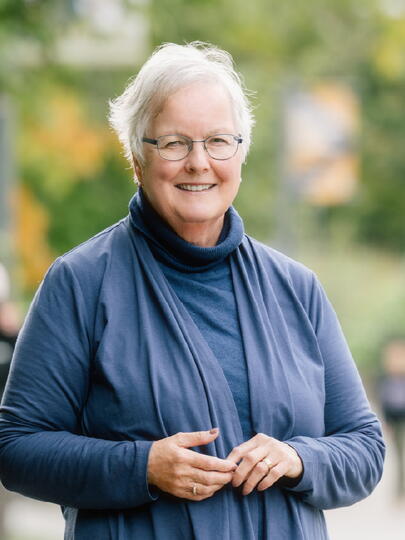
“I was jumping for joy,” she says. “Universities bring talent, ideas, and community. I knew it would propel the Okanagan to a whole new level.”
As a mother of four and an experienced educator, Mary also recognized what a world-class university in her backyard could mean for her own family. Over its first two decades, she and her children—Joel, JoyAnne, Tim, and Jeff Krupa—found support in UBCO’s close-knit community and strong faculty relationships. Their time at the university helped shape interests that would evolve into careers spanning education technology, rural healthcare, public policy, and particle physics.
A family built on “educo”
Mary grew up in an academic household where her father, a professor, often spoke about educo, the Greek root of “education,” meaning “to bring out” or “develop from within.” It shaped her parenting philosophy of no preset paths, no one-size-fits-all expectations for her children. “They’re different people,” she says. “The goal was to help bring out their potential, wherever it led.”
UBC Okanagan helped launch that potential. With smaller cohorts, close faculty relationships, and diverse opportunities for student leadership roles, the campus offered Mary and each of her children room to explore their interests and grow academically in their home community.
Merging technology with nature education: Mary Clark (MEd’15) and Dr. Joel Krupa (BA’08)
Mary completed her Master of Education at UBCO in 2015. Already an accomplished educator, she led science-based initiatives to encourage youth to engage with science and the natural world, and while working with artist Robert Bateman, she recognized that technology was reshaping how young people learned. Her thesis on augmented reality gaming in STEM education became the foundation for Agents of Discovery, the award-winning ed-tech company she co-founded with her son Joel.
“That program gave me the knowledge—and the inspiration—to turn an idea into a real company,” she says.

Joel, the first Krupa child to attend UBCO, earned his Bachelor of Arts in 2008. Staying local provided stability during the transition to university, and faculty mentorship helped set the stage for the academic path that followed. He went on to complete a Bachelor of Science at the University of London, a Master of Science at the University of Oxford, and a PhD at the University of Toronto. He also completed postdoctoral fellowships at both UBC and Harvard University.
Over the years, Joel has held several leadership and advisory roles in sustainability-oriented organizations, as well as taught at UBCO. Today, he is the chief academic officer of Agents of Discovery and continues to research sustainability challenges and opportunities.
Caring for the health of the Interior: Dr. JoyAnne Krupa (BSN’10)
JoyAnne Krupa graduated from UBC Okanagan’s Bachelor of Science in Nursing program in 2010, during a period when the campus was expanding its role in strengthening healthcare across the Interior. Her education provided hands-on learning, thoughtful mentorship, and early exposure to the realities of rural and community-based care.
After working as a registered nurse, she went on to study medicine at the University of Calgary and completed her residency at UBC’s South Okanagan-Similkameen Family Practice Program. Today, she practices rural family medicine in the East Kootenays, helping to improve access to care for rural communities and supporting the health and well-being of families across the region.
From student advocacy to economic policy: Tim Krupa (BSc’13, MA’15)
By the time Tim Krupa arrived at UBCO, the campus was maturing quickly. A natural advocate with a passion for public policy, he found meaningful opportunities in its small, accessible community, working as an undergraduate researcher, physics teaching assistant, and student representative on UBC’s Board of Governors.
After earning his Bachelor of Science at UBCO in 2013 and Master of Arts at UBC Vancouver in 2015, Tim deepened his knowledge of public policy and business at the University of Oxford, where he studied as a Pershing Square Scholar. Guided by a curiosity to understand how the world works, he went on to become an economist and, in 2021, put his name forward as the Liberal candidate for the Kelowna-Lake Country riding.
Today, Tim serves as the policy director in the Prime Minister’s Office in Ottawa, drawing on his Okanagan roots to help support policies aimed at building a strong and inclusive economy.
Global research that began in a supportive campus community: Dr. Jeff Krupa (BSc’17)
Studying physics at UBCO with just a handful of professors, Jeff Krupa gained valuable access to labs and mentorship, graduating with a Bachelor of Science in 2017. His early research in ultrafast optics and terahertz spectroscopy helped launch him into a PhD program at MIT.

Today, Jeff is a postdoctoral researcher at SLAC National Accelerator Laboratory at Stanford and at CERN, where he develops AI methods for particle physics. His trajectory into global research grew from the early mentorship and research opportunities that were available to him when he started his academic journey at UBCO’s small, supportive campus.
A university coming of age
Ask Mary what the Krupa experience proves, and she doesn’t hesitate: “There’s nowhere in the world you can’t go from UBCO. The experience showed us what can happen when people are supported to learn and explore.”
For her family, that meant five futures shaped by a campus that offered opportunity, close connections, and an environment that allowed educo in its truest sense—bringing out their potential and all they are capable of becoming.