














Changemakers
Symphony of the sea
A marine biologist invites us to listen to the underwater world of Howe Sound.
Photo: Thomas Fruin
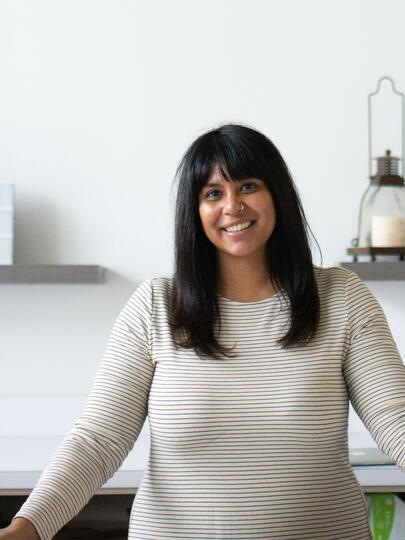
“We were standing in it, and you could feel them all over your feet,” says April Houweling, describing the spring day in 2023 when a mass of writhing herring appeared near the shoreline of Lions Bay on BC’s Howe Sound. Neighbours had gleefully alerted April to the presence of the fish, prompting her to run to the water and wade straight in. And that was the moment, surrounded by a salty spray and gleaming scales, that she decided on a mission: to deploy a microphone under the sea.
A scientist, scuba diver, and surfer, April visits the ocean near her home most days. For decades, Átl’ka7tsem/Howe Sound was plagued by toxic runoff from an old mine that devastated its ecosystem. A major remediation was initiated in 2001, and the waters are seeing new signs of life.
April sensed the shift when she saw the herring in Lion’s Bay that spring day, after years of absence. Soon enough, seagulls swooped down and sea lions showed up. Then the orcas and humpbacks arrived. Lions Bay residents were seeing whales in their briny backyard for the first time in living memory. April wants her community to hear them, too.
A year ago, she and fiancé Tom Fruin co-founded the community-based organization Howe Sound Revival, which aims to document the resurgence of life. This involves the launch of an underwater microphone, called a hydrophone, through partnerships with BC Whales and the BC Hydrophone Network. Other collaborators include The Audain Foundation and Ocean Film Festival.
As a bioacoustician, April specializes in sounds made and heard by sea creatures. She’s eavesdropped on the crackles of sea urchins, the low frequency groans and knocks of fish, and the roars of harbour seals beneath the waves. Her specialty is the calls and songs of whales, and the noise pollution from boat traffic that muffles them.
While April has a freshly minted Master of Science degree from SFU, her career in marine biology began at UBC. She studied seaweed there as an undergraduate, before moving on to cetaceans like dolphins, humpbacks, and orcas—from the tiny island of Niue near New Zealand, to the tiny island of Saturna in BC.
Over the years, she has listened to countless soundbites recorded by hydrophones. If others could hear the ocean too, thinks April, they will be more invested in the wellbeing of its inhabitants. She relates to what David Attenborough once said: “No one will protect what they don’t care about; and no one will care about what they have never experienced.”
Once the hydrophone is anchored off the shore next year, citizen scientists will aid in the validation of marine fauna sounds to support research and conservation. And their reward, beyond the data, is the music. If the sound of the ocean is stored within a single seashell washed up at low tide, imagine the symphonies soaked up by a hydrophone. Wouldn’t we ask for an encore?