



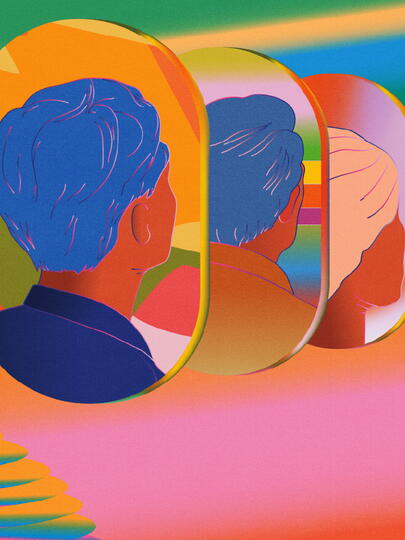










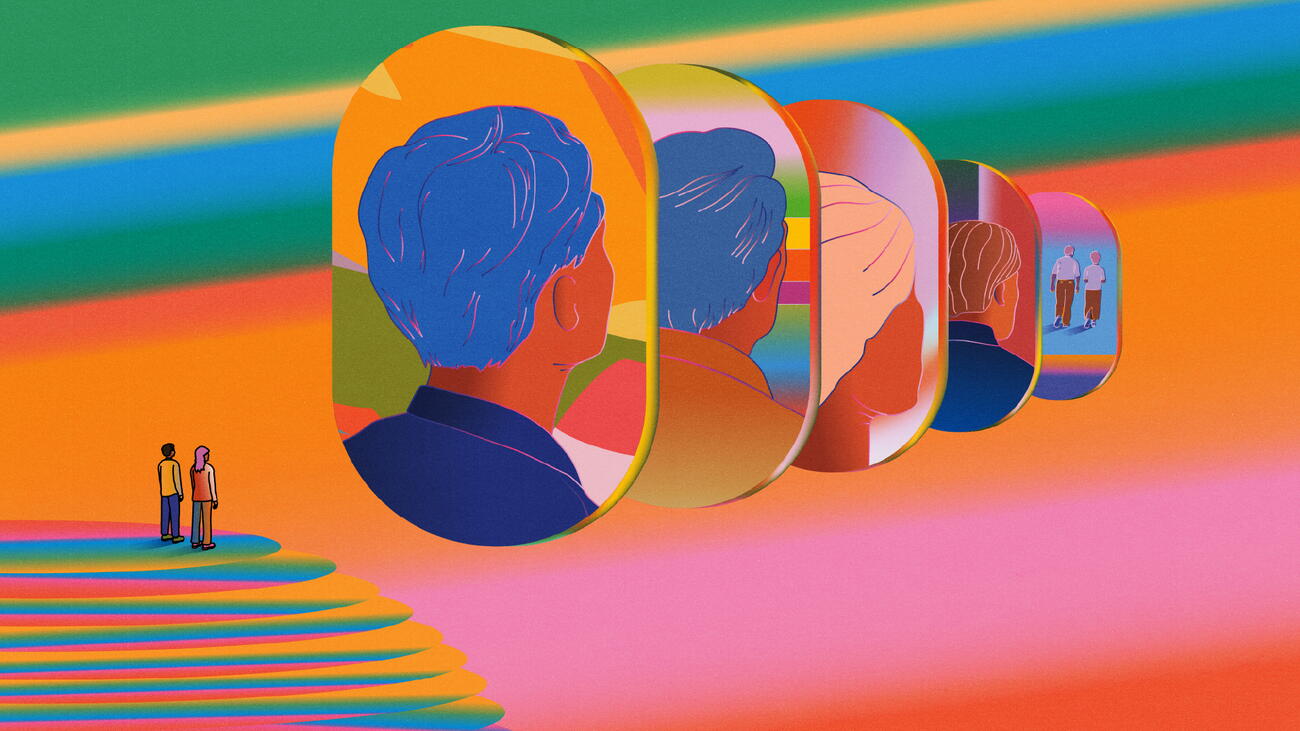
Illustration by Seba Cestaro
The last “acceptable” prejudice
Ageism is getting old. It’s time to ditch the stereotypes.
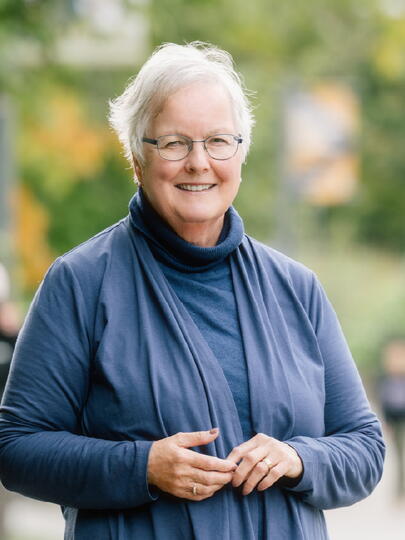
A few years ago, Dr. Judy Segal, a UBC emeritus professor of English, was visiting the Vancouver Aquarium with her then four-year-old granddaughter. At the ticket desk she encountered something that gave her pause. There were two price categories for children—under and over four years old. Yet there weren’t two categories for adults—under and over age 65. There was just “adult” and “senior.” Once you become a senior, you were apparently no longer an adult. Dr. Segal found this dispiriting but not surprising. A world expert in the rhetoric of health and medicine, she has seen the subtle verbal diminishment of older people—from trivializing to exclusion to outright erasure—in more ways than she can count. This example was just “one of the thousand cuts of ageism.” Dr. Segal ordered her tickets: “One child under four; one adult over 65.” The next day, she wrote to the aquarium’s administration to suggest a revision to price categories.
There is a theory in philosophy that things become what we name them. The language we use shapes the thoughts we think shapes the language we use—and round and round we go. As social pressures ratchet up intergenerational tensions, we see it reflected in the way we talk about older people as a group. We speak of the “grey tsunami” that’s going to swamp the healthcare system, the “curse” of dementia, the greed of selfish Boomers who torched the planet, stalled social justice, and are now clinging to their jobs, leaving twentysomethings to moulder in the unemployment lines.
Ageism is hate speech that has slipped past the gatekeepers, discrimination that has seeped into the groundwater. The World Health Organization reports it’s more pervasive than racism or sexism, but you’d never know it. Ageism can be experienced by people of any age (think how often children are dismissed for being “too young”), but is experienced most profoundly by those past midlife.
Even as data about ageism and its ill effects roll in, there remains the widespread view that dissing old age is just, well, telling it like it is. anything else is just denial.
“Ageism is the last ‘acceptable’ prejudice,” says Julia Henderson (PhD’18), an assistant professor in UBC’s Department of Occupational Science and Occupational Therapy who, for her doctoral thesis, examined representations of older people in North American theatre. (Spoiler alert: overall, not a pretty picture. Although Dr. Henderson focused on plays that pushed back against stereotypes, the raison d’être for older characters in a play’s plot is often just… being old. They tend to function as the source of jokes or a narrative device—like the redshirts on Star Trek, they’re probably going to die, thereby setting up the real story.) Ageism is the lingua franca of self-deprecating humour for anyone even approaching middle age. “I actually keep a collection of ageist greeting cards,” says Dr. Henderson. “It’s incredible what you see. If they were about race or gender instead, people would be outraged—they’d be picketing the store.”
Something else that makes ageism different: It’s the only prejudice we hold against ourselves—our future selves, that is. Typically, when we’re young and encounter attacks against “our group”—be it gender, race, body type—we develop strategies, psychological antibodies, so we can better slough off such opinions going forward. Ageism is different. Young people tend not to identify with older people and their concerns, until one day the circles converge; the young, now old, find themselves undefended against the very stereotypes they absorbed and perpetrated. And they sink to their own low estimation of themselves.
Exactly why ageism is so profound and pervasive is a bit beyond the scope of this conversation, but a prevailing theory is that contempt toward older people is rooted in fear. Robert N. Butler, the pioneering geriatrician who coined the term “ageism” and devoted his career to improving the life and health of elders, likened today’s prejudice against them to the scorn and revulsion people felt toward lepers in the Middle Ages: “We’re terrified we will end up as they are.” Old age, like leprosy, is something you’d really rather not “catch.”
But (ironically) it may be ageism, and not aging, that we need to be wary of. Twenty years ago, the Yale psychologist and epidemiologist Becca Levy conducted a now-famous study on residents of a small town in Ohio. She was curious as to whether our attitudes about aging might affect the way we actually (physiologically) age. She asked them if they saw growing old as something to fear or something to embrace (or something in between). Twenty-three years later, Levy and her team revisited the town, found as many of the original subjects as they could, and matched their survey answers with health and mortality data.
It turned out that the subjects with the most negative views of aging died 7.5 years sooner than those with the most positive views. It was a staggering result, elevating mindset to one of the most powerful influencers of lifespan we know of. If the finding was replicated by subsequent research, it would mean attitude matters more than gender. Or loneliness. Or socioeconomic status. Or smoking. Or exercise.
And it wasn’t just lifespan that was affected by mindset. Levy’s group found striking differences in other health metrics—including balance, handwriting, memory, and even hearing.
Recently, a team of UBC psychologists revisited the mindset research, but with a more dynamic element to the questioning. Over a four-year period, investigators asked a randomized group of subjects to describe the extent to which they agreed with statements like “Things keep getting worse as I get older,” “I am as happy now as I was when I was younger,” and “The older I get, the more useless I feel.” Four years later, the researchers found that those whose attitudes had trended positively showed measurable improvements in health and wellbeing. “Our findings suggest that interventions to increase aging satisfaction might improve the health and wellbeing of our rapidly growing older adult population,” said Julia Nakamura (MA’22), a UBC graduate student in psychology who was the first author of the paper.
Even as data about ageism and its ill effects roll in, there remains the widespread view that dissing old age is just, well, telling it like it is. Anything else is just denial. “Let’s be honest, growing older is psychologically punishing,” the British journalist Ian Leslie wrote in his Substack newsletter recently. “How could it not be? It involves getting a little bit weaker, stupider and uglier every year.”
Actually, not every culture feels that way—or not to this degree. While ageism is indeed a global phenomenon, other countries aren’t as ageist as Western democracies.
there’s a perceptual gulf between what many young people assume it’s like to grow old and what older people actually experience.
“Western culture has a medicalized view of aging, so many people assume that once things start going wrong with our physical health that our quality of life will sharply decline,” says Lillian Hung, a professor in UBC’s School of Nursing. “But that’s not actually what older people are reporting.” Recently Dr. Hung oversaw an international collaboration on cultural perspectives called the Cultural Aging Project. It examined the experience of aging across seven countries. Participants answered survey questions available in three languages. The suite of questions (e.g., Have you ever felt left out? Do you have spiritual support? How do you cope with stress?) boiled down to “How satisfied are you with your life?”
The answer, in sum: Very, thanks for asking. Latino cultures reported being most satisfied. It wasn’t that respondents had fewer aches and pains and health problems—it was more that they accepted them as part of the deal of this phase of life, outweighed by the compensations of memories and family and spiritual richness. “It’s kind of inevitable that there’s some physical decline, but it’s really about learning how to cope well, and building resilience,” says Dr. Hung. Of the countries tested, Canada scored lowest on life satisfaction, but it still scored highly: 86 per cent reported their life was “very good.”
“Older people are happy with their life, even with its challenges,” says Dr. Hung. Clearly, there’s a perceptual gulf between what many young people assume it’s like to grow old and what older people actually experience. “Maybe what we’re learning is: Don’t form your assumptions from second-hand information—but actually talk to older people.”
To that end, she developed a new UBC nursing course, Diverse Perspectives on Aging, now taught by her former grad student Paulina Santaella Tafolla (MHLP’23). It involves students collaborating with an older person in their life. Every week the pair spends 30 to 60 minutes together. The student poses questions such as: What brings you happiness? How do you face challenges? By the end of it, the students’ ageism has been pretty much wiped out. “They come to realize that aging is a natural process,” says Dr. Hung. A takeaway of cross-cultural studies is that they offer proof that “aging” is at least in part a social construct. That ageism is malleable. “Personally,” says Dr. Hung, laughing, “it gives me hope.”
Without doubt, a major reframe is in order for how we think about aging in this culture.
In one of her many other roles at UBC, Dr. Henderson, the OT prof, runs the Elders CREATE Lab—which promotes innovative ways to elevate older creators. One recent project—a collaboration with Western Gold Theatre (one of just two professional theatre companies in Canada devoted to supporting artists aged 55+) was called “Reclaiming the Senior Moment.” It’s a series of Instagram videos challenging stereotypes; instead of depicting a “senior moment” as a pantomime of forgetfulness or incompetence, the vignettes show seniors creating moments of inspiration, wisdom, or connection.
“There’s a close relationship between ageism and ableism,” Dr. Henderson says, so she helps design theatre productions with creative accommodations that reduce barriers to entry for older actors. “If there are more older bodies on the stages of the world, and more thoughtful, non-ageist stories being told, this works to counter ageism on a cultural level.”
Taken together, these kinds of interventions will, one hopes, shake the zeitgeist. And take the pressure off Boomers feeling like they have to be enthusiastic personal ambassadors for the brand of the older human. “I’ve sometimes found myself trying to demonstrate to my grandchildren that I am absolutely the most fun person they have ever met,” says Judy Segal. “It can be exhausting.”
But the rhetorician in her ponders how old age can best be reframed in public discourse and representation—how people might be persuaded to see it as a stage in life that is different from youth or middle age, but not implicitly to be dreaded. “People, when they are young, must come to understand themselves as continuous with the people they will be when they are old,” she says, “because everyone is damaged by ageism.”