











A ramp with a gentle incline winds around the atrium at the Blusson Spinal Cord Centre, giving wheelchair users an alternative to the elevators. Photo: Martin Dee
A look inside ICORD, where science meets humanity
UBC researchers are reimagining recovery after spinal cord injury.
At the front of the room, an X-ray image of a spine filled the screen.
Dr. Brian Kwon, a surgeon-scientist at Vancouver General Hospital and professor in UBC’s department of orthopaedics, explained to the audience that spinal cord injuries can look very different in different patients. Some have obvious fractures, while others can have injuries that are barely visible but just as devastating.
Rarely do we consider what it would mean if the image on the screen were ours, he added.
“You look at an X-ray like this and think, yes, it’s terrible, but that happens to other people,” said Dr. Kwon. “But sometimes the X-rays belong to one of our own.”
This X-ray belongs to Dr. Fabio Rossi.
A professor of medical genetics at UBC, Dr. Rossi has spent decades studying how the body repairs itself, and why sometimes it can’t. When a serious cycling accident in 2022 left him partially paralyzed, the research he once viewed through a microscope suddenly became personal.
When it was his turn to speak, Dr. Rossi said his experience on “the other side” of research—this time as a patient rather than a scientist—has given him new perspective.
“You realize it’s not just about the research,” he said. “It’s about people.”
Their reflections came during a June event at the Blusson Spinal Cord Centre at Vancouver General Hospital, where Drs. Kwon and Rossi addressed a gathering of researchers, students, and community partners.
The event, hosted by the International Collaboration on Repair Discoveries (ICORD)—which is supported by UBC’s Faculty of Medicine and Vancouver Coastal Health Research Institute—preceded a special lab and clinic tour for UBC President and Vice-Chancellor Dr. Benoit-Antoine Bacon, Canada’s “Man in Motion” Rick Hansen, and the Blusson family, whose support helped make the centre possible, among other senior leaders at UBC.
As Dr. Kwon, who is also the director of ICORD and the Tier 1 Canada Research Chair in Spinal Cord Injury, explained, ICORD’s mission is both simple and ambitious: to make spinal cord injury preventable, livable, and ultimately curable. The tour demonstrated that mission in action.

creating a community
On the main floor of the building, Dr. Andrea Bundon, associate professor in the UBC School of Kinesiology and principal investigator at ICORD, led the group through the Yuel Family Physical Activity Research Centre (PARC), an accessible gym where people with spinal cord injuries come to exercise using adapted equipment, much of which is designed on site.
“Exercise supports circulation, bone health, and mental wellbeing,” said Dr. Bundon. “But it’s also about connection and creating a community where people can stay active and engaged for years, even decades, after their injury.”
Linda Hunt, who has been coming to PARC since her injury more than 10 years ago, spoke about how the space has become an anchor in her daily life.
“When I come here, I don’t have to explain anything to anybody,” she said. “Everybody gets it.”
designed for everyone
From the gym, the group followed a gently curving ramp, called the George Gaffney Infinity Ramp, that winds around the atrium to the second floor’s Brenda & David McLean Integrated Spine Health Clinic. The ramp itself is a design statement—about 200 metres long with a five per cent incline and level platforms every 10 metres. Coloured glass panels along its edge filter light across the space, creating a sense of movement as you climb. The ramp’s gradual incline also allows visitors who use wheelchairs to reach the third level without having to take the elevators, if they prefer.
Designed by Musson Cattell Mackey Partnership Architects in consultation with ICORD researchers, the entire Blusson Spinal Cord Centre was built to be universally accessible. Every detail was planned to reduce the need for accessibility signage or special accommodation. For example, elevators, washrooms, and doorways were all designed to be usable by everyone, without exception.

integrating patient care and discovery
Once in the clinic, the group was met by clinician-scientist Dr. Kate Anderson and her team in the urology diagnostics room, the busiest area of the clinic.
As a urologist, Dr. Anderson and her team provide urodynamics testing, an often overlooked but critical part of spinal cord injury care that helps support bladder health. She explained how people with spinal cord injury often face serious bladder storage and emptying problems. Urodynamics helps prevent upper urinary tract damage, which can be life-threatening, and guides long-term bladder management strategies like catheterization.
“When you ask thousands of patients what they want most, bladder health consistently comes first,” she said.
A significant benefit of an integrated clinic where a diverse range of specialists share the space is that it allows for “hallway conversations” that often lead to new research ideas, said Dr. Anderson.
For example, she and her team are currently working on developing implantable devices that can detect changes in bladder pressure and stimulate nerves to restore function. They demonstrated two experimental devices—a tiny bladder-pressure sensor and a nerve stimulator—that could eventually work together to automatically relieve bladder pressure before it causes harm.
“These are the kinds of innovations that could make a profound difference in daily life for people living with spinal cord injury,” she said.

science that starts with patients
In the rehabilitation gym on the third floor, Dr. Michael Berger, a clinician-scientist specializing in spinal cord rehabilitation, described what he calls his “reverse translation” approach—a process that starts with the everyday challenges patients describe in clinic.
“They tell us what’s not working for them, and we take those problems back to the lab to find solutions,” he said. “It’s about taking what we learn from lived experience and using it to push the science forward.”
Dr. Berger introduced one of his patients, Dan, who recently underwent nerve transfer surgery after breaking his neck in 2016. Nerve transfer surgery uses healthy nerves above the site of injury to restore movement below it, allowing signals from the brain to reroute through intact pathways.
Holding his hand open and closing it again, Dan demonstrated how his function has improved since the procedure.
“Now I can open my hand and just grab,” he said. “It may not be perfect, but it gives me back independence.”
where prevention begins
The final stop on the tour was the Orthopaedic and Injury Biomechanics Lab, where researchers study how to make activities like cycling and mountain biking safer.
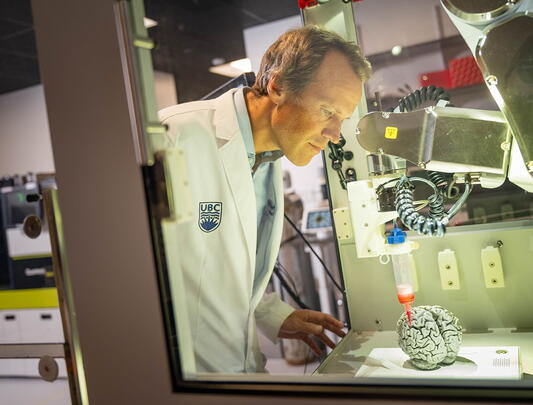
Biomedical engineers here simulate real-world crashes to understand how the body and protective equipment respond to impact, with the goal of designing helmets that can better prevent the types of injuries that lead to paralysis.
Dr. Kwon explained that prevention is a vital part of ICORD’s mission, just as important as recovery.
“We want to understand how these injuries happen in the first place so we can stop them from happening at all,” he said.

driven by purpose
As the visit drew to a close, Dr. Kwon spoke about the importance of ICORD’s work.
“If you were with me on the ward yesterday, comforting the mother of a young man who’s now paralyzed with a thoracic spinal cord injury, you would know that the work here matters,” he said. “It’s why we push, why we stay up late analyzing data, why we’re here at six in the morning starting experiments, why we engage so passionately with our community.
“We know there’s so much still to do, and we can’t do it alone.”