















RIP Kip: What cherished campus coyote’s death tells us about his life
Kip the coyote became a beloved figure at UBC before his tragic death in 2024. His story now helps researchers understand urban wildlife and promote safe coexistence between coyotes, people, and pets.
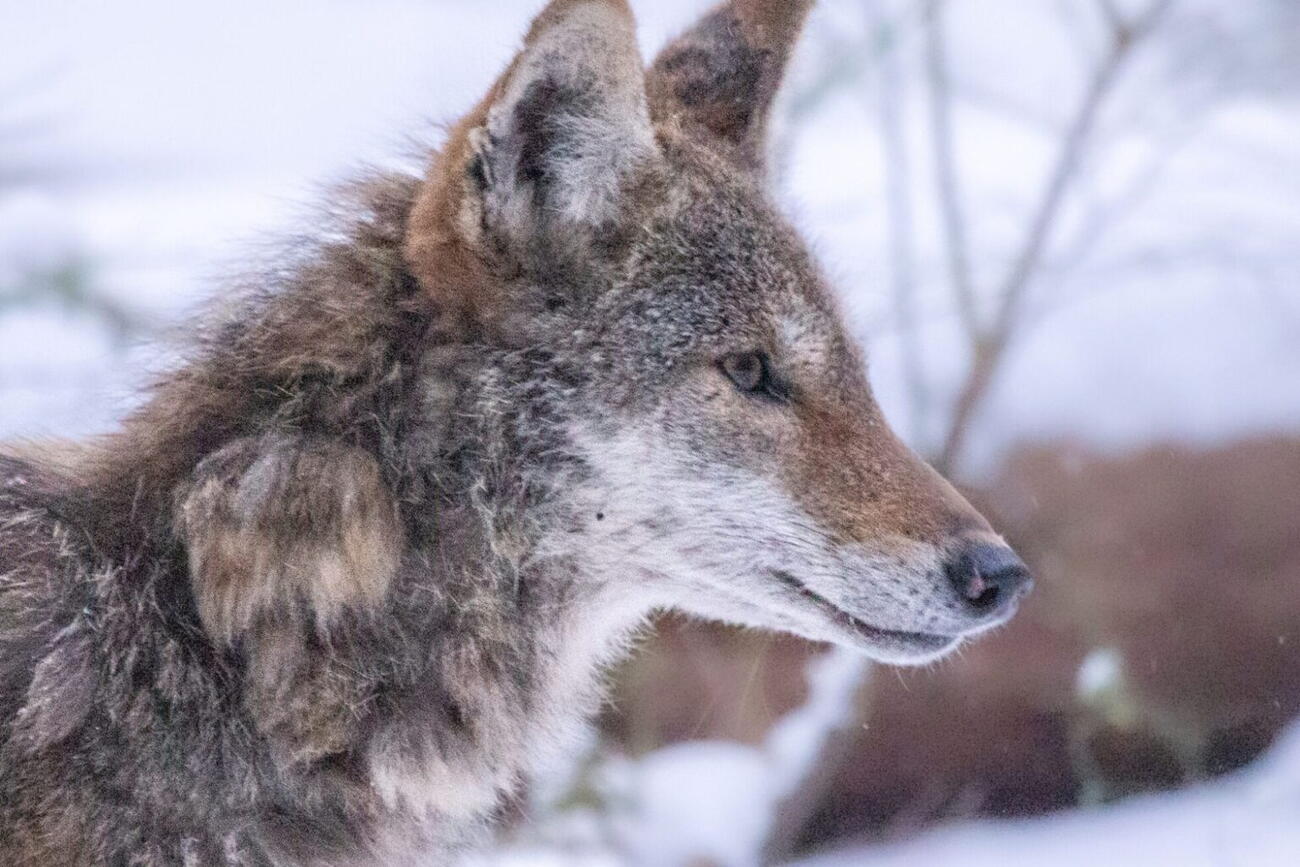
In his short life, Kip—a coyote with one bad leg—became an unofficial mascot on UBC’s Vancouver campus.
He was a frequent sight, sleeping in the open, basking in the sun, and hunting down squirrels. Kip’s casual limping strolls across the campus, when he seemed oblivious to throngs of people around him, were legendary.
A car hit Kip sometime after he was born in early 2020, causing the limp first seen on a trail camera in November of that year. He was later struck and killed by another vehicle near the Botanical Garden in October of 2024. As tragic as his death was, it provided UBC researchers a unique opportunity to learn more about his life.
Third-year PhD candidate Iris Li is focussing on the ecology and physiology of urban coyotes. She performed a necropsy on Kip at Beaty Biodiversity Museum after his body was retrieved. (Kip’s remains are being respectfully preserved and he will stay in the museum so that future generations can continue to learn about and from him.)
The results showed a not-wild-enough wild animal, likely with a bleak future. While massive internal injuries from the vehicle killed Kip, his body and observed behaviours prior to his death showed he quite possibly would have continued having interactions with people that were too close for comfort.
“At 16 kilograms, he was one of the heaviest coyotes I’ve ever seen,” said Li, who has performed 80 coyote necropsies in her research to date. Kip’s fat reservoir suggested he was supplementing his natural diet with human food, Li said, and the later isotopic analysis proved that theory.
Notably, both Li and Dr. Sarah Benson-Amram (Associate Professor, UBC Department of Forest and Conservation Sciences and Department of Zoology) had witnessed Kip eating garbage and being fed by people on several occasions.
“He’d lost his fear of humans,” said Dr. Benson-Amram. “He was close to dangerous interactions with area pets and people—for example, attacking leashed dogs. If those conflicts continued there’s a possibility he would have had to be removed. He was definitely showing too much habituation to humans.
“Kip’s death was obviously very sad. You watch these animals for years—you get attached to them.”

By taking tissue samples and performing various biochemical analyses of Kip and other deceased coyotes, Dr. Benson-Amram and Li are able to determine the dietary strategies and body conditions of urban coyotes. That data can be used to inform outreach and management efforts.
“The reason we do this work is because we love animals and we want to reduce the need to euthanize any animals. We want to help coyotes, people, and pets coexist safely in cities,” said Dr. Benson-Amram.
Back when Kip was first observed at UBC, he was skittish around people thanks to the campus being largely empty during COVID-19.
At that time, experts provided the same advice they provide today when it comes to ensuring urban and campus coyotes coexist with people. That advice is especially relevant with the estimated five coyotes that are living primarily on campus now:
- Do not feed them! Coyotes do not need human food to survive.
- An injured coyote does not mean it will be an aggressive coyote, but it’s best not to approach it in case it feels threatened.
- It’s best to keep pets on leash in greenspaces and forests to prevent predation. Off-leash dogs may also charge at coyotes, forcing the wild animals to defend themselves.
- Keep trash and compost contained so it doesn’t attract coyotes.
If you see a coyote on campus the best guidance is to “haze” it: essentially scaring it so it doesn’t become too accustomed to being around people as Kip eventually became. Hazing can mean making a lot of noise, raising your arms to look big, throwing rocks near them, opening and closing an umbrella, or using another kind of noisemaker to scare them away.